
Click to open expanded view
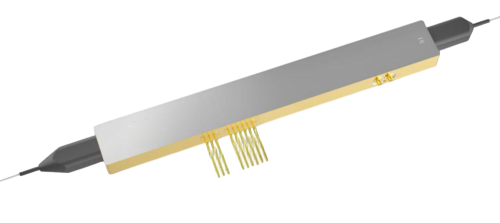
Модулятор IQ
The 20 GHz X 2 lithium niobate IQ modulator is based on a dual Mach-Zehnder electro-optic modulator (MZM) design with a dual parallel structure. The electro-optic bandwidth of each modulator is greater than 20 GHz, and the addition of an integrated photodiode provides automatic bias control (ABC).
Main Characteristics
• Titanium diffusion process
• The working wavelength is 1530-1570 nm
• Operating bandwidth > 20 GHz
• Low optical insertion loss
• Integrated photodiode
• Meet Telcordia GR-468-Core communication specification
Application
• OFDM modulation
• QPSK modulation
• QAM modulation
• CS-SSB
• FMCW Autopilot Lidar
Absolute Maximum Rating
|
Parameter |
Condition |
Minimum value |
Maximum value |
Unit |
|
Maximum RF input power (electrical) |
RF port AC-coupled AC |
- |
10 |
Vpk-pk |
|
Maximum input optical power (optical) |
Continuous power CW |
- |
100 |
mW |
|
DC Voltage at DC port |
- |
- 40 |
40 |
V |
|
MPD reverse current |
- |
- |
< 2 |
mA |
|
MPD forward current |
- |
- |
< 10 |
mA |
|
MPD reverse voltage |
- |
- |
< 15 |
V |
|
Enclosure operating temperature |
- |
- 5 |
+ 75 |
°C |
|
Rate of change of maximum operating temperature |
- |
- |
5 |
°C/min |
|
Storage temperature |
- |
- |
+ 85 |
°C |
|
Operating humidity |
Non-condensing |
5 |
85 |
% |
|
Pin Soldering Temperature |
- |
- |
250 |
°C |
|
Maximum lead bonding time |
- |
- |
10 |
s |
Technical parameters
|
Parameter |
Condition (1) |
Minimum value |
Typical value |
Maximum value |
Unit |
|
Optical parameters |
|||||
|
Operating wavelength range |
- |
1525 |
- |
1570 |
nm |
|
Insertion Loss, IL (2) |
EOL, -5 ~ + 75 ℃, full C-band |
- |
5.0 |
7.0 |
dB |
|
Phase-MZI extinction ratio |
@ DC |
24 |
- |
- |
dB |
|
Extinction ratio of RF-MZI |
@ DC |
24 |
29 |
|
dB |
|
Polarization extinction ratio PER |
- |
20 |
- |
- |
dB |
|
Return Loss, RL |
Input and output |
40 |
- |
- |
dB |
|
RF Interface-Electrical Parameters |
|||||
|
Sub-MZI Vπ |
@ 1 kHz |
- |
5.0 |
7.0 |
V |
|
Carrier suppression ratio (3) |
@ 15 GHz |
To be determined |
- |
- |
dB |
|
Sideband suppression ratio |
@ 15 GHz |
To be determined |
- |
- |
dB |
|
Sub-MZI-3 dB electro-optic bandwidth |
Relative to 2 GHz |
20 |
23 |
- |
GHz |
|
Sub-MZI S21 Flatness |
300 MHz - 20 GHz |
- 1 |
- |
1 |
dB |
|
Sub-MZI Amplitude Difference (S21) |
- |
- 1 |
- |
1 |
dB |
|
Sub-MZI delay |
- |
- 5 |
- |
5 |
ps |
|
RF-MZI return loss S11 |
40 MHz - 17 GHz 17 GHz - 30 GHz |
10 8 |
12 10 |
- - |
dB |
|
Parameter |
Condition 1 |
Minimum value |
Typical value |
Maximum value |
Unit |
|
Bias Interface-Electrical Parameters (4) |
|||||
|
Sub-MZI bias voltage Vπ |
@ 1 kHz |
- |
7 |
8 |
V |
|
Mother MZI bias voltage Vπ |
@ 1 kHz |
- |
7 |
8 |
V |
|
Variation of all MZI bias voltages Vπ in the full operating band |
At 1550 nm |
- 5 |
- |
5 |
% |
|
Bias interface impedance |
@ DC |
1 |
- |
- |
MΩ |
|
MPD parameter (5)) |
|||||
|
PD Responsiveness (6) |
- |
20 |
- |
120 |
mA/W |
|
The linearity |
- |
-10 |
- |
10 |
% |
|
Phase deviation (7)(8) |
The PD is not reversed |
-5 |
- |
5 |
Degree |
(1) Top = 25 C, BOL, wavelength 1550 nm, unless specifically marked
(2) The insertion loss is measured at the highest point of transfer function of MZI
(3) Test method TBD
(4) Each bias port includes two pins, a differential voltage input,
(5) Total input mPD
(6) The mPD responsivity is defined as:
· Sub-MZI is set at the maximum output point
· Bias voltage is applied to the mother MZI
· Responsivity R = (Im _ -3 dB)/ (Pout _ -3 dB)
· Im _ -3 dB is the current of the mPD when the optical output is at the maximum point of -3 dB
· Pout _ -3 dB is the optical power when the optical output is at the maximum point of -3 dB
(7) The mPD phase difference is the difference between the mPD and the maximum or minimum of the output optical power
(8) ± 5 ° of mPD phase difference is equivalent to ± 2.8%
Если вам нужна дополнительная информация, ,пожалуйста, свяжитесь с нами.

